

Building Community Trust Through Social Media
Social media is an integral communication tool for municipalities, offering a way to participate in online community conversations and guide the narrative around projects and policies It provides an impactful space for storytelling, and rewards consistent engagement over time. A strong social media presence builds trust, allowing constituents to view their government entity as a reliable source of information that accurately represents their community.
Where to Start? A (Very) Broad Guide to Social Media
Create a Content Strategy:
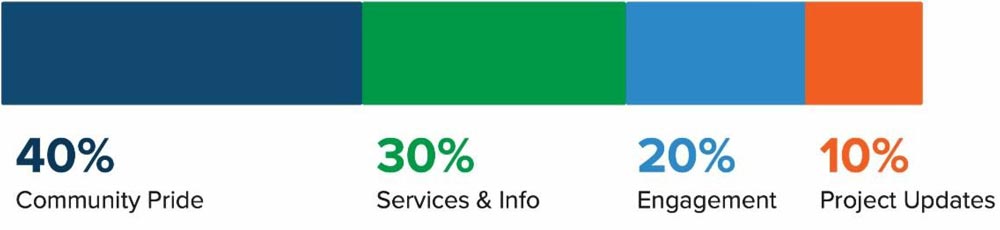
Consider how individual posts contribute to your community’s story as a whole. Municipal social media often defaults to being reactionary (a street closure, a lost pet, a holiday greeting) which leaves little room for a cohesive narrative. What story does your community want to tell? What do you value, and what makes you unique? Turn the priorities from your strategic plan or broader initiatives into content buckets that align with your community goals.
Set Your Tone of Voice:
Keep in mind that your content is competing with non-professional, algorithm-tailored content that users choose to subscribe to when relaxing. Your post about a community event is likely followed by a cat video or a meme. So, how can we make sure people are invested in your content and stop scrolling long enough to process it? Set a human tone that’s friendly and conversational.
Common Municipal Tone:
“The Department of Public Works notifies residents of the commencement of Phase II infrastructure activities along State Route 48 beginning August 14th, weather permitting.”
Social Media Fluent Tone:
“Heads up, neighbors 👋 We’re starting road work on SR-48 on August 14th. We’ll keep you posted every step of the way. Questions? Drop them below.”
The goal isn’t to prevent your audience from scrolling, but to trigger a half-second pause; just enough for them to remember your post or become familiar with your brand.
Build a Visual Strategy:
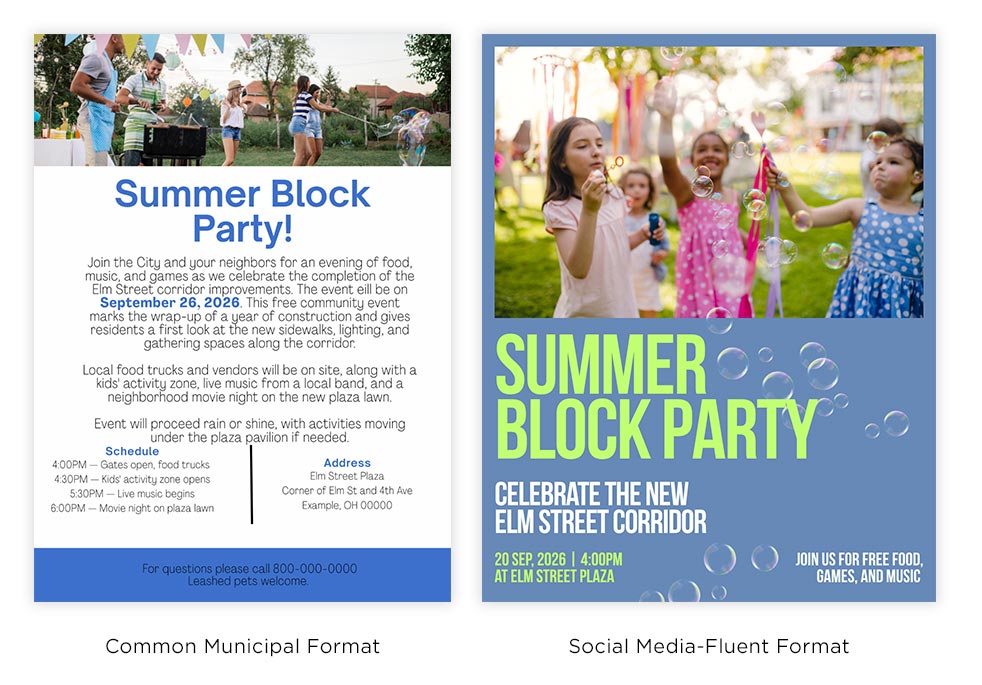
Municipal feeds are often full of dense, text-laden flyer format posts which pose the same issue as an overly formal tone of voice: it’s boring and will likely get scrolled past (remember, you’re competing with cat videos!). A strong visual strategy focuses on creating movement and momentum in your posts, whether it be an action photo, an eye-catching graphic, or a video. Do something unexpected to catch your audience’s attention and keep them on your post for the few seconds they need to interact with your story. A few simple tactics to accomplish this:
- Stick to the 80/20 rule – Keep text to 20% of the page, 80% key visual elements
- Utilize a Call-to-Action – Only include the most important details on your post (keep it brief) and utilize links to direct engaged audience members where they can learn more
- Prioritize video – Video consistently outperforms other forms of content across platforms and algorithms favor short-form (30 seconds or less) videos.
Employ Tools & Resources:
A content calendar and analytic tracking play critical roles in delivering consistent content that resonates with your residents (especially for small or low-capacity teams).There are numerous free and inexpensive resources to supportteams with limited capacity or budget, including:
- Canva: Free graphic design for posts, flyers and stories with easy drag-and-drop templates
- CapCut: Free video editing app for Reels & TikToks with auto-captions and trending effects
- Meta Business Suite: Free tool to schedule and manage Facebook and Instagram in one place
- Buffer: Social media management platform with a free plan; schedule up to 3 channels with simple queue and basic analytics
- Hootsuite Free: Limited free plan for scheduling, beneficial for managing multiple platforms
- Google Analytics: Free and integrates with all platforms to track website traffic from social media.
Project Communications
While a large part of the role of municipal social media is to build a feed that represents the best of your community, there is also the responsibility of acting as a trusted source of information. Project communications, while not as fun as posting about last week’s parade, are essential to function as a reliable source.
Proactive disclosure of project information establishes your channels as the authoritative source before alternative narratives form. In practice, this means sharing project timelines and potential closures or disruptors before residents experience them, celebrating wins and milestones along the way, and promoting transparency and engagement through FAQ posts.
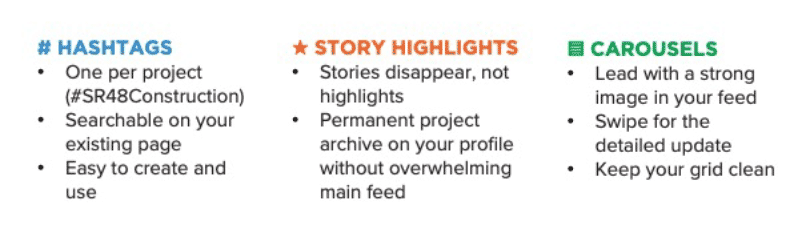
Project content can be integrated with brand content by utilizing formats that make it possible to disseminate important information while keeping your feed polished. Common examples include hashtags to make projects searchable on your page, story highlights on Instagram, Tiktok, and Facebook, and leading with a strong, clean image in a carousel.
As municipalities navigate an increasingly digital landscape, social media will continue to play a central role in how communities communicate and stay informed. Investing in a consistent media presence positions local governments to meet residents where they already are while building trust.