

Transportation Safety: The Myth, The Mayhem, and The Management, Part 2
Civic Minds Podcast Episode #2
In part 2 of this episode of Civic Minds, Environmental Design Group Associate Director of Transportation, Reneé Wittenberger, PE, returns to continue the conversation around transportation safety and the strategies communities can use to create safer roadways. Joined by host Laura Hengle, Reneé dives into how safety studies, comprehensive safety action plans, and proactive infrastructure improvements help communities prioritize long-term roadway safety investments.
Throughout the discussion, Reneé shares how traffic engineers evaluate crash patterns, identify opportunities for safer road design, and incorporate improvements like sidewalks, bikeways, and roundabouts into existing roadway projects. She also addresses common misconceptions around congestion and roundabouts while highlighting how thoughtful traffic engineering solutions can reduce severe crashes, improve traffic flow, and create safer experiences for everyone on the road.
Civic Minds Podcast Episode #2 Transcript
Laura Hengle:
Welcome to Civic Minds, a podcast by Environmental Design Group, highlighting civil engineering, planning, and design. I’m your host, Laura Hengle. Today, we pick up with part two of our conversation with Reneé Wittenberger. Having discussed some of the myths and the mayhem, we’ll now dive into the management of traffic safety. So, Reneé, we’ve talked about safety studies and planning, and if a community were to want to do a safety study, is that part of an existing plan or does the plan come out of the study? And if they pursue that, what would the return on investment possibly be?
Reneé:
Yeah. So, let’s take one step back. Another way to incorporate safety features, safety improvements, is if you have a project, a roadway project already planned, such as a road resurfacing or a signal replacement or something that’s already in your plan of things to improve, you can check and see if it’s a high crash location or if there are a lot of pedestrians or other reasons to add a little bit more to that project to improve safety. So rather than starting with a clean slate and completely replacing a signal with a roundabout, which is still a great idea, but if you already have a construction improvement project going, adding safety features to that is another low-cost way to improve safety.
And to know if this is a good time to spend our safety dollars or not, having a comprehensive safety action plan is one way to be able to do that. I know the city of Akron, when we’re talking about certain features to include on a roadway, if it’s on the high injury network that was created with AMETS’ comprehensive safety action plan, then they add the safety features. And if it wasn’t, then they save that safety money for another project that would make a more direct improvement based on crash history. So having some sort of area-wide plan can help direct your efforts and the money that you have available. And comprehensive safety action plans aren’t the only things you could have an active transportation plan, which looks at the whole area and finds reasons and ways that people are using infrastructure and why they might want to bike from here to here, or walk from here to here.
And so that plan sets it out. So, when, for example, you’re resurfacing a roadway, you could look and see if it’s on this plan. And if that is identified as a good location for bike infrastructure or for pedestrian infrastructure, you could consider making wider shoulders for those things or adding a sidewalk while you’re doing it. School travel plans are another thing that help with that. And school travel plans mostly focus on the two miles around each school, and they determine the main routes to school that the kids would be walking or biking if they were to use that mode. And so, once you have those routes highlighted, you can put those on your list of, we want to add sidewalks to the city. Here are the first 10 places that we want to do that because they’ll have the biggest impact to the most students trying to get to school.
Then these plans also can highlight super high crash areas that really need to have a good look at that we would recommend a safety study for that. And so, the safety study will piece through the crashes that have happened in the last three to five years and figure out what the problem is, what is actually happening. And I don’t know if I’ve told you this before, but every time we’re assigned a safety study, I’m always a little bit nervous. Like, what if I can’t crack the code? What if I can’t figure it out this time? What if I don’t know why we have all of these crashes in this particular way?
And there’s always a reason. Sometimes it takes a little bit of experience to see. So, if you’re having high crashes, high numbers of crashes in either severity or frequency, there is definitely something that you can do about it. And it just would take a study to look at all of the probable causes of crashes and then what are the solutions. And then how do we work those solutions into what you have here?
Often a roundabout is a great solution if we have angle crashes, but not often does that work in what you have planned, in the money available. So, then there are short-term countermeasures and medium-term countermeasures that you can apply right away as you’re working on funding towards whatever your ultimate solution would be.
So, with a safety study, you can use that to seek funding through ODOT or through federal sources as well. And there’s generally a match required, either 10 or 20 percent. But I will give a little plug for roundabouts. They are allowed to be 100 percent funded by federal funds. Most things you cannot. Most things federal will be up to 80 percent, but certain pedestrian improvements and roundabouts can be funded for the full 100 percent.
Laura:
Which may explain why we’re seeing so many of them cropping up.
Reneé:
Or, yeah, maybe. Also, they’re just really good solutions.
Laura:
I know. And I know we’ll talk more about that, but you’ve made me a believer.
Reneé:
Good, good. And so a safety study, depending on what you have, you know, that could cost between $25,000 to $100,000 if it’s a really long corridor. And that could get you $5 million or more in safety funding. So, the return on investment is really high for just a safety study that clearly outlines the problem, the solution, the cost of the solution, and how that would work with circumstances that you have.
Laura:
So, to sort of launch that, someone would go to someone like yourself, a transportation engineer, to do the Comprehensive Safety Action Plan if needed, and also the safety study. It’s both done in the same wheelhouse by the same type of professional?
Reneé:
Yes. I would say the Comprehensive Safety Action Plans get a little help from planners, regional planners, local planners. But mostly, it is very data-based, and the safety study engineers would be a good choice.
Laura:
And what I love is, you know, you’re always afraid you’re not going to crack the code, but so far, so good.
Reneé:
100%.
Laura:
And maybe you’re not happy with the results that you found, like, well, this could have been avoided for the last 25 years, but at least now you have a path to move forward.
Reneé:
Yes, yes, I do. You reminded me of a study that we’re working on in a county near here, and there are two intersections that are really close together and they’re at the top of a hill. And we’ve got all of these fixed object crashes, but it’s fixed object has run-off-the-road. If we have all these run-off-the-road crashes, lots and lots of problems, and we’re analyzing it based on the speeds that we have there with it being, it appears to be not posted. So, 55 mile an hour per the Ohio revised code. And then after we had done all the work, we found that actually the speed limit had been lowered in 1958 to 45 miles an hour and it just wasn’t posted. And what that tells me that this has been a problem since longer than you and me and everyone we know have been alive.
Laura:
People knew at least by 1958 that they needed to make this change.
Reneé:
Yes. Not that lowering the speed limit actually improves things. It does not cause people to drive slower because as we’ve said, people drive as fast as they feel safe driving. So even if it was posted, it probably would not have that big of an effect.
Laura:
And sometimes it’s just a historic reference because I’ll find myself back in my old hometown, which is pretty rural, and I’ll have someone with me that’s not from that and like, “Why are we going this fast?”
I’m like, “I don’t know. think it’s just because we always have.” And we need to be trained into other paths.
Reneé:
Right, right. It feels safe to do it. It’s been safe for you every time you did it.
Laura:
That’s right, until it wouldn’t be.
Reneé:
Until it’s not.
Laura:
That leads me into some of our, one of the things, I mean have to say, I’ve known you for a few years now. There’s a lot of terminology that kind of comes around safety studies and pedestrians, and all safety, really. You mentioned a few, “congestion saves lives.” You mentioned to me the other day, which I had not thought about, and we had a deep dive conversation on that. Road diets was a term I never knew until I started working at Environmental Design Group. I thought it was a typo the first time I saw it. My favorite is “look left and drive.” You know this. I’d say this all the time. I try to teach it to all the people I know because it has made me a believer in the roundabout.
So, what are some of your favorite phrases and can you explain a little bit about them and why that is? I mean, it could be some of the ones I mentioned already or it could be others.
Reneé:
Well, you have the best ones. So, road diet, diet inherently sounds like I’m being deprived, right? Like I can’t have ice cream after dinner. So that was a real disservice. Whoever named road diets to the country at large. It’s right sizing. It’s making the number of lanes and the size of the lanes appropriate for the amount of traffic that we have and improving safety for it. So, I wish I would stop calling it a road diet as well as everyone else, but I think it’s stuck.
Laura:
Here to stay.
Reneé:
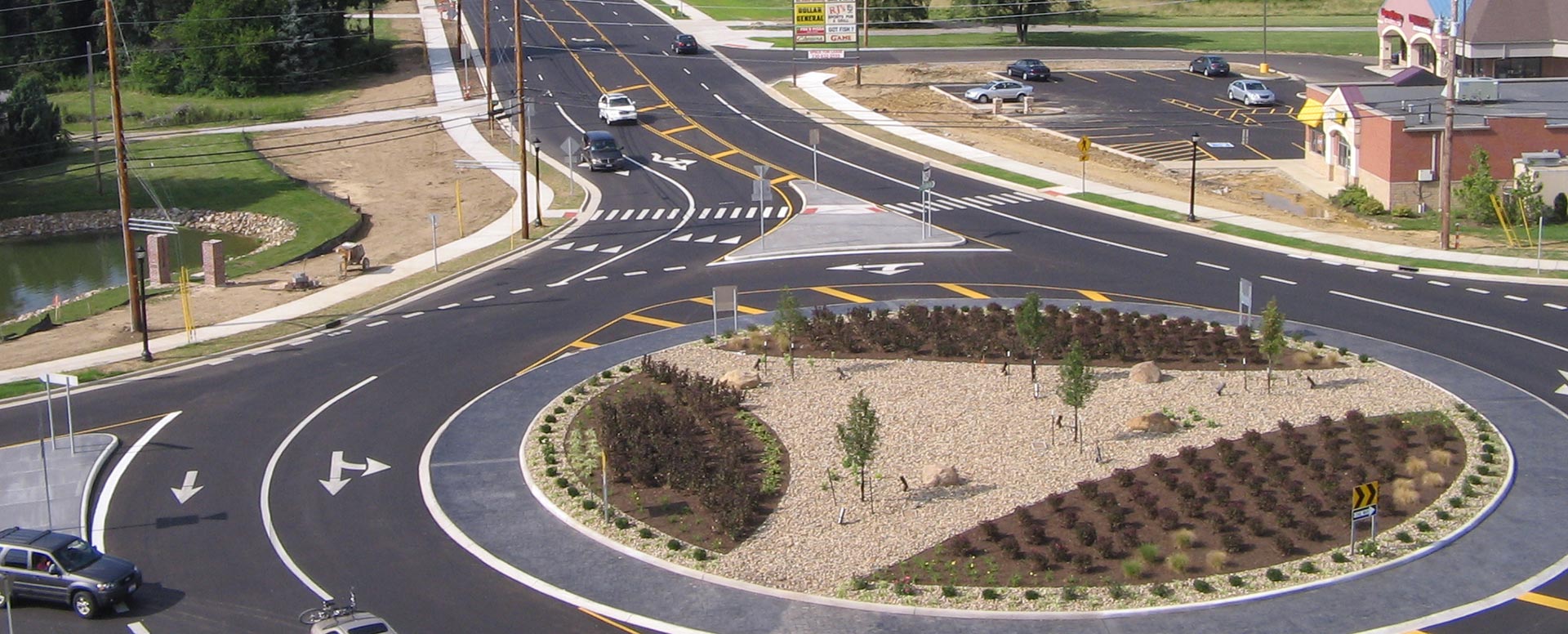
Yeah, I think it’s here to stay. And then the idea that roundabouts cause crashes. People, man, they really get uptight about roundabouts. And they talk about their high school kid learning how to drive and how scary that will be for them. And they talk about their older parents or grandparents. And the truth is roundabouts reduce the number of conflicts. They reduce the number of decisions that you have to make when you approach one. All you have to do is look left and if no one’s coming, you can go. And if someone’s coming, you wait. So –
Laura:
Works every time.
Reneé:
It works. It works every time. But even though there are some crashes of people that are confused and not sure how to use a roundabout, they still reduce crashes by 82%. And almost nobody dies at roundabouts, like ever. So, I think that’s important to bring up.
Laura:
I know you mentioned that because just by their very nature, the rate of speed is slower. And I think these are sometimes things that people don’t understand about the reason that the roundabout was put in. It wasn’t just to take a traffic light out or a stop sign out. It was to reduce the speed of traffic and as you’ve said earlier, slower traffic is less catastrophic accidents and that type of thing.
Reneé:
Yes. And similar to the road diet, crashes weren’t the reason that I became on team roundabout. I went to a presentation when they were not that popular around here in Northeast Ohio and the presenter, the first thing he said was no waiting. When we have roundabouts, there’s no waiting. Everyone’s still moving the whole time. And as we’ve made clear now, I don’t like waiting. I don’t like things to take a long time, just like everybody else. And so that’s when I became a believer. And it was only after that that I learned about the huge improvement in safety and the lives no longer lost at those locations.
I had a comprehensive safety action plan at a county and I had a lot of people there to talk and give input. And there were some people questioning our recommendations of roundabouts in certain locations and a police officer took the mic stood up and said, “Look, everyone, you hate roundabouts. I hate roundabouts.”
And I said, “I don’t hate roundabouts.”
And he ignored me and kept talking and said, “But I’ll tell you what, we don’t go to these high crash locations anymore. Once there’s a roundabout in it, they’re a non-issue. We can do other things with our time, with the tax dollar money.” And I thought that was a really powerful positive thing to say about roundabouts. And I wish that I had a recording of that and that I could play that everywhere. But I think that’s really important.
Laura:
Right. So, it’s not just you saying it, it’s others saying it.
Reneé:
Yes.
Laura:
And again, it just, once you learn how to do it, and it just took the one phrase, “look left and drive.” And I started doing that because every week I go through two of them. And I just thought to myself, this does work. Reneé was right. Just look left and drive. And I’ve talked about this with other people at the office. And I’m like, I became a believer because I’m like, you seize up, you see it coming, like, “oh my gosh, it’s a roundabout.” Not if you know what you’re going to do. You’re going to get there, you look left, and you’re going to drive.
Reneé:
Yes. And I didn’t invent roundabouts. I wish I had. think someone in Europe invented them a long time ago. But I will say, people who hate roundabouts, if they’re willing to say that in my presence, then I can give them these basic things that we’ve already talked about on here. And they’ve changed their minds because these are very true facts. And then they approach roundabouts and they think about them differently and they realize, oh, I did get through that faster than I used to. And then knowing the safety improvements, it’s really just a matter of one-on-one conversations.
Laura:
Yeah, it has to become your own realization. One day it’s clear like why this is working. At least that’s what it was for me. And I know you mentioned recently to me about “congestion saves lives.” And I think that might harken back to some of the things we talked about earlier. Is that with the less lanes? Because again, we’re not getting zigzagging traffic. We’re not doing all of those things. People are like, “we need more lanes here. We need more lanes here. It’s too crazy. My commute is awful.” But you’re saying that’s not always necessarily the solution.
Reneé:
Yeah. And we learned that in COVID. So, we were starting to come around to the idea that ah, these places with a lot of congestion, yes, we have a lot of bump type crashes, you know, property damage only crashes, but we don’t have the fatalities. And then in 2020, when we all went to work from home, the roadways became these high-speed raceways that people who did need to drive somewhere, they could drive as fast as they wanted. And with nothing to slow them down with these wide-open areas, the fatality and severe injury crashes increased like crazy. And we realized that’s because no one was there to drive slower.
So, congestion, while again, we don’t love rear end crashes, and that is something that comes along with congestion sometimes, does cause everyone to drive at a reasonable pace. You cannot drive faster than the people in front of you. You know, I don’t like traffic either. I do not like bumper-to-bumper traffic. But when you think about the time lost, maybe it’s one- or two-minutes max on this one route that you might take because of the congestion. When you think about the life you save, maybe your own, those one or two minutes really aren’t that big of a deal anymore.
Laura:
Yeah. Well, I think that this has told me even a lot more than I knew before I came into this. I hope that a lot of people that listen to this recognize the importance of considering the safety in their own municipality, whether it’s a small rural community or a large municipality. And as you mentioned, it’s bikers, it’s walkers, it’s cars, it’s the whole gambit of things coming together. And how do they all share space and safely get from one destination to the other? And I think taking the time out to think about, “does my town need to have a safety study done? Do we need to rethink some things?” Hopefully we’ve given some people some pause to do that, but is there any closing comments you want to share with anyone before we sign off here today?
Reneé:
Yes. I recently, I knew of this phrase, but I recently dug into it a little bit. And maybe you’ve heard it. Someone said, “take it easy driving. The life you save may be mine.” And that was James Dean. He was doing a public service announcement, and he was supposed to say, “Take it easy. The life you save may be your own.” That one’s pretty popular, right? But he said, “may be mine.” And then 13 days later, he died in a car crash from someone else driving too fast.
Laura:
Yes.
Reneé:
So, I recently learned all of that. And so now it’s my most important phrase, “Take it easy. The life you save may be mine.”
Laura:
Well, thank you so much for being here today. I hope a lot of people have some things to take away from this and think about and make some improvements in their own local communities. And if not, you’re always a resource, I’m sure. People can reach out and find you and see what they can do to make change and look left and drive as they approach that next roundabout. Thanks so much Reneé.
Reneé:
Thank you, Laura.